The Boards Beneath the Beam: Britain’s Hidden Cinema Stages Step Back into the Light
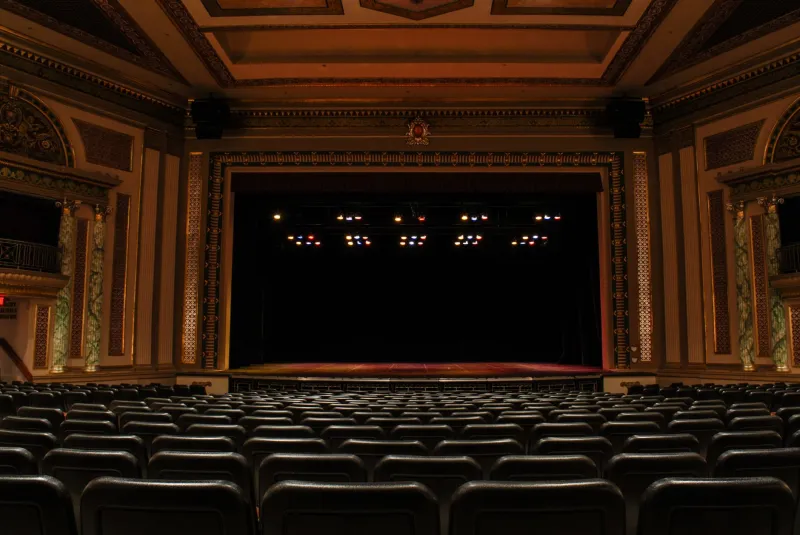
Stand at the back of an old picturehouse auditorium and look at the screen. Now look below it. In plenty of Britain’s surviving cinemas, there is a stage down there — a proper one, with a proscenium arch, wing space and a cluster of dressing rooms behind it. It is one of the quietest bits of cinema heritage we have, and in 2026 it is also one of the busiest.
Many British cinemas were never just cinemas. They were variety houses, community halls with a projector, places built for a full evening out rather than a single feature. The screen got top billing for most of the week, but the building was designed to host pantomimes, amateur operatics, dance bands, civic meetings and the kind of live turns that kept a town’s high street buzzing after dark. The stage was not an afterthought. In some houses, it was the reason the auditorium was so deep in the first place.
A building that expected a second act
Walk into a cinema that feels unusually long from the back row to the screen and you may be standing in a former cine-variety house. Look up: is there a high, flat ceiling above the screen, or a grid of steelwork lurking behind the decorative plaster? Look to the sides: are there narrow gaps between the auditorium wall and the screen frame, just wide enough for a performer to wait in the wings? Look behind the building: is there a modest stage door, a loading bay that seems too generous for film cans, or a staircase leading to rooms that do not quite match the public areas?
These are the clues. A fly tower may have been truncated. A stage may have been boarded over and carpeted. The footlights might be capped, the prompt corner turned into a store cupboard, the dressing room mirrors painted over. But the bones often remain. Volunteers restoring old picturehouses frequently find hemp lines, pulley blocks, original stage paint and the faint outlines of scenery flats on backstage walls. Sometimes they find generations of signatures from panto casts and local drama groups, pencilled onto brickwork like a guest book no one meant to keep.
What got covered up, and why
The story is rarely one of deliberate erasure. It is mostly economics. With the coming of sound and the rise of the cinema as a dedicated film venue, live performance became less central to the business model. Later came bingo, then retail conversions, then the multiplex era. Stages were boarded over because the space was needed for storage, because the screen was lowered, because heating a fly tower was expensive, or simply because no one was booking variety any more. The stage did not vanish. It was put to sleep under hardboard, carpet and a few decades of good intentions.
That makes the current wave of interest rather moving. Across Britain, local groups are peeling back those layers with torches, brooms and a certain amount of nerve. Some are doing it as part of wider cinema restorations; others are simply trying to make a much-loved building useful again. The work is rarely glamorous. It involves asbestos surveys, fire regulations, worn-out ropes and the question of how to make a 1930s stage work for a 2020s audience without sanding away everything that makes it interesting.
The volunteers with torches and brooms
Cinema preservation tends to celebrate the auditorium: the seats, the curtains, the foyer, the sign. The stage is a quieter project. It sits behind the screen, literally and figuratively. But spend an afternoon with a volunteer group clearing a backstage corridor and you start to hear the building differently. A dressing room sink tells you performers once washed off greasepaint here. A row of hooks tells you a chorus once fought for space. A fire curtain, stiff with age but still hanging, tells you someone took the safety of a live audience seriously long before anyone was restoring the plasterwork.
On heritage trails, these spaces are often the ones that stop people in their tracks. They are not polished. They smell of dust and old wood. They feel like the working half of a building that was designed to be looked at from the front. For local people, they also hold a different kind of memory: the school production, the Sunday concert, the pantomime that went on ten minutes too long, the prize-giving where someone’s dad got a laugh by dropping the trophy.
A new bill for an old stage
The good news is that some of these stages are coming back into use. Live comedy, acoustic music, film-plus-Q&A events, community theatre, youth groups and the occasional Christmas panto are all finding a home in restored picturehouses. A working stage gives a cinema flexibility. It can host a screening on Friday and a local band on Saturday. It can bring in audiences who would not come for a film, and it can give a town a mid-sized room that is not a leisure centre or a draughty church hall.
There are practical debates, of course. Acoustics are different from a purpose-built theatre. Sightlines can be awkward if the seating rake was designed for a screen rather than a person standing downstage. Backstage access may be tight, and licensing takes time. Restoration teams have to decide how much to modernise and how much to leave visible. Do you install a new lighting rig or keep the old switchboard as a heritage display? Do you restore the dressing rooms for performers or open them to tours? There is no single answer, and that is part of the interest.
What matters is that the stage is being considered at all. For years, cinema heritage often meant saving the front of the house. Now the conversation is widening to the whole building: the booth, the staff room, the canopy, the aisle lights and, yes, the boards under the screen. These are not separate stories. They are all part of how a picturehouse worked as a social machine.
So next time you settle into an old cinema, look below the screen before the lights go down. There may be a whole other performance space down there, waiting for its next cue. If you have memories of a live show in a British picturehouse — a panto, a prize night, a band, a local play — The Picture House Project would love to hear them. The best heritage trails are the ones that lead back to someone’s Saturday night.