Rows of Evidence: What Britain's Old Cinema Seats Still Tell Us About How We Watched
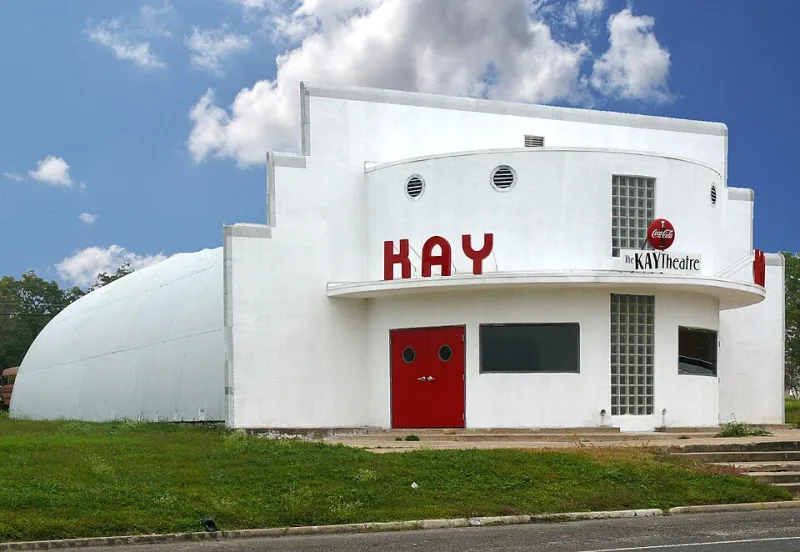
Photo: Joe Haupt from USA, CC BY-SA 2.0, via Wikimedia Commons
Nobody restores a cinema because of the chairs. And yet the chairs are where every restoration ends up, in a meeting that runs long, with a fabric swatch on the table and a spreadsheet that will not balance. Seats are the most-touched object in the building and the least-examined piece of its heritage. We sit in them for two hours, remember them for forty years, and then rip them out.
The seat as evidence
Look at a row of original 1930s frames and you are reading a business plan. Tip-up mechanisms existed partly so ushers could sweep a row without lifting every cushion, and partly so an aisle could clear quickly. Seat widths tell you what a manager thought of his audience's comfort. The distance to the screen tells you what he thought a film was. Balcony seating tells you about pricing, class and the strange British habit of charging more for the view from above.
Those are not decorative details. They are the physical record of how a town went to the pictures — which is why the seating decision in a refurbishment is a heritage decision, whether or not anyone frames it that way.
Wood, horsehair and the business of sitting
The earliest picturehouse seats were often borrowed from the music hall: hard, hinged, built to be wiped down. By the 1930s the supercinemas had gone upholstered, with sprung frames and deep backs, and the whole room was designed so that you entered it, rather than merely sat in it. Post-war seats got plainer and more utilitarian. Then the multiplex arrived and something odd happened: seats got wider in some directions and shallower in others, upholstery became a marketing device, and the word 'stadium' entered the language of a building with no terraces.
What got lost along the way is the small ritual. The tip-up that snaps back and startles the row. The armrest negotiation. The coat over the back. The aisle seat claimed by someone who is not going to need it. Ask anyone over fifty about their favourite seat in a demolished cinema and you will get a number, a side of the aisle, and a reason.
The accuracy problem
Here is the uncomfortable truth for anyone drafting a restoration brief: an authentically restored 1936 seat is a rotten place to watch a two-and-a-half-hour film. Frames were narrower, legroom was tighter, and horsehair padding has a limited future. Restoring a hundred of them to museum standard might satisfy a historian and alienate an audience, and an audience that does not come back is not a heritage win.
The honest middle path is usually a hybrid — original frames and end standards retained where they can be safely reused, new interiors built to modern standards, and a small number of genuinely original seats conserved and displayed rather than sat on. It is less romantic than a full period reupholstery, and vastly more likely to keep the lights on.
Fire, fabric and the rules nobody sees
The unglamorous constraint is fire performance. Upholstered seating in a public building has to meet strict standards for ignitability and, depending on the space, for how the whole assembly behaves in a fire. That usually rules out the pretty wool-mix fabric in the sample book, and it can rule out the original foam too. Add wear ratings, cleaning regimes, and the simple fact that a seat in row F takes ten times the abuse of one in row A, and the specification writes itself.
None of this is visible to the audience, which is exactly why it needs explaining. Heritage bodies and local amenity societies are far more supportive when they can see why the fabric changed.
Sightlines, steps and the inclusive question
The most interesting argument in seating is not about looks at all. It is about who fits.
Older picturehouses were built to a rake and a step pattern that assumed a certain kind of body and a certain kind of mobility. Every wheelchair space added to a historic auditorium costs seats, often in a prime position, and often more than one because of companion seating. Level access to the front of the stalls can mean removing a row. Hearing loops, aisle widths, handrails and contrasting step edges all compete for the same square metres that the box office would rather sell.
That trade-off is real and it should be made in public rather than in a back office. A cinema that gains six accessible positions and loses eight standard seats has not 'reduced capacity'. It has changed who is invited — and for a community picturehouse, that is the whole argument.
What to do with a row of 1936 frames
If you are on a restoration committee, three practical suggestions. First, photograph and measure the original seating before it goes to the skip; that survey is heritage evidence and it costs almost nothing. Second, retain a sample row — frames, standards, even a mechanism — as a display or a bench in the foyer, so the building still contains the thing it replaced. Third, talk to the people who sat in them while they still can, because seating is the most memory-loaded object in the building.
And if you are simply an audience member: notice your seat next time. The width, the rake, the armrest that does not quite fit. Somebody argued about that. Somebody lost. The rows are evidence, and they are still being written.