Behind the Tab: The Quiet Craft of Restoring Britain’s Picturehouse Curtains

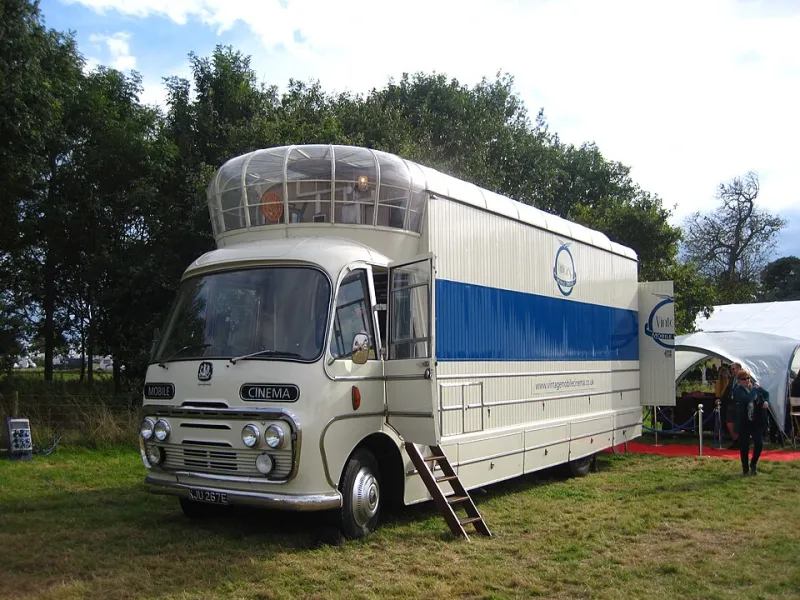
Photo: Jim Evans, CC BY-SA 4.0, via Wikimedia Commons
Walk into a restored picturehouse and the chances are you will look at the screen, the plasterwork, the seats, maybe the organ. You probably will not look at the curtain. Until it moves. Then the whole room remembers what it is for.
A tab, a teaser, a house curtain — call it what you like — is one of the least discussed details of cinema restoration and one of the most theatrical. It is the thing that turns a projection into an event. And in Britain, a small network of textile conservators, stage riggers and stubborn cinema volunteers is quietly making sure the big reveal still happens.
The bit that moves
Margaret Ellison, a textile conservator based in West Yorkshire, describes the work as part forensics, part upholstery and part stagecraft. ‘People think a curtain is just a big bit of fabric,’ she says. ‘It is not. It is a mechanical object with a memory. It has been pulled, pleated, patched and sometimes painted. You have to listen to what it has been through.’
Old picturehouse curtains were often made from heavy velour, wool rep or a cotton-and-rayon mix, lined and weighted so they fell in clean folds. The best had a slight sheen that caught the auditorium lights as they opened. Some had braid trims, embroidered crests or a contrasting teaser across the top — a short curtain that framed the screen before the main tabs parted. In the 1930s, a cinema might have had a house curtain in cream and crimson, a set of black tabs for film shows and a separate teaser for stage turns. By the 1950s, pastel shades and simpler rigs were common. By the 1970s, many had been boxed in, painted over or removed altogether.
‘The first thing we do is not clean it,’ says Ellison. ‘It is document it. Where are the seams? Which way does the nap run? Has it been shortened? Has someone cut a hole for a speaker? That tells you how the room was used.’
Ropes, weights and the smell of old velour
Restoring a curtain is not simply a matter of hanging new fabric. The rigging matters. Traditional tabs ran on counterweighted lines, with a fly floor or a small hemp house behind the screen. In smaller halls, a single operator might have pulled a rope from the side of the stage, watching the tabs sweep open in time with the lights. Lose that mechanism and you lose the timing — the pause, the rustle, the hush.
Danny Rooke, a stage rigger who has worked on several restored cinema stages, says the biggest surprise is how much of the original kit survives. ‘You will find the headrail still there, the pulleys still there, maybe a bit of old rope that has gone hard as a fossil,’ he says. ‘What you rarely find is anyone who knows how it was operated. So you ring the oldest person in the building. Then you ring the person they suggest.’
That oral knowledge is fragile. In one case, a retired projectionist remembered that the tabs were not opened by a single pull but by a two-stage operation: a teaser first, then the main curtain, with the house lights dimming between the two. It sounded fussy until they tried it. ‘Suddenly it felt like a cinema again,’ says Rooke. ‘Not a room with a screen in it.’
Colour, weight and the question of authenticity
Fabric choice is where heritage and practicality collide. Original velours were often deep in colour — burgundy, forest green, royal blue — because they absorbed light and made the screen pop. But old dyes fade, and modern flame-retardant treatments can change the handle and sheen of a cloth. Conservators often patch rather than replace, matching weave and weight where they can and accepting that a curtain with visible history is not the same as a curtain with visible holes.
‘There is a temptation to go neutral,’ says Ellison. ‘Grey, taupe, something safe. But a picturehouse curtain was never meant to be safe. It was meant to be a bit of a show-off.’
At the Plaza in Stockport, the auditorium’s stage and organ chamber give a sense of how a cinema could double as a variety house. At the Rex in Berkhamsted, the art deco lines do much of the talking, but a curtain set against them changes the acoustics of the room — not just the sound, but the atmosphere. Even a modern audience, used to screens that appear from nowhere, responds to the ritual.
What audiences remember
Ask people what they remember about a childhood cinema and they rarely mention the plaster. They mention the lights going down, the curtain opening, the moment before the film. That is not nostalgia for fabric. It is nostalgia for anticipation.
Restoring a tab is expensive, slow and almost invisible when done well. It will never draw a crowd the way a restored organ or a reopened foyer will. But it is one of the few restoration details that audiences feel in their bodies. The rustle, the pause, the slight draught — it is a small piece of theatre that says: you are not at home. You are here.
And in a country where so many picturehouses have been chopped into flats, supermarkets or grey office space, that is worth a bit of rope, a lot of patience and a very heavy hem.