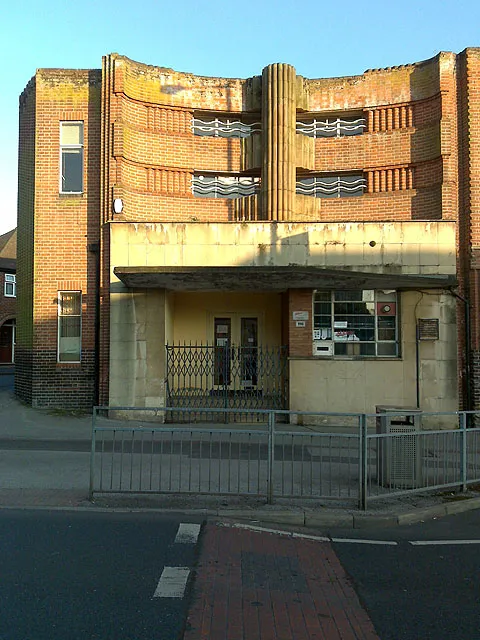
Look Up, Look Again: The Former Picturehouses Hiding in Plain Sight on Britain's High Streets
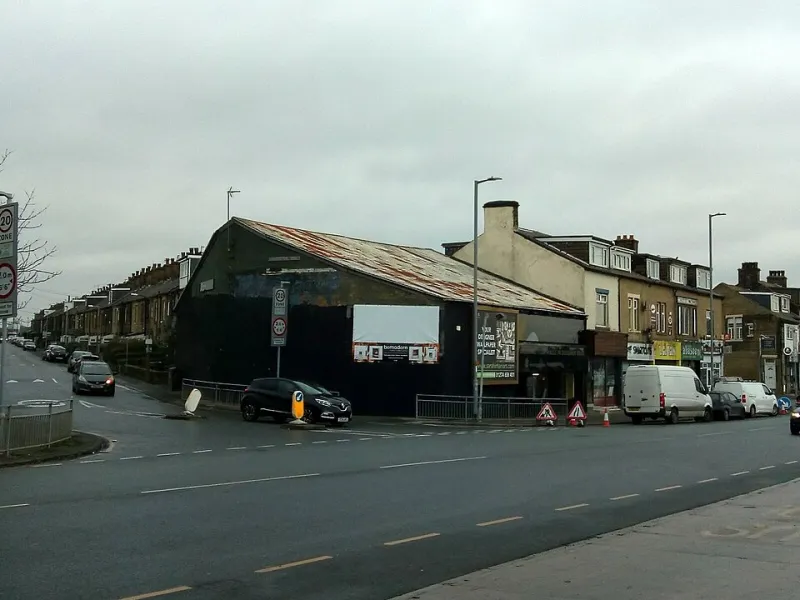
Photo: Stephen Armstrong , CC BY-SA 2.0, via Wikimedia Commons
Stand outside the discount store on almost any British high street and look above the signage. There is a good chance you will see a stepped parapet, a stone band, a row of blind windows bricked in decades ago. Walk round the back and the shape gives it away: a great windowless slab of a building, taller than anything beside it, with a flat roof where a projection box used to sit.
That is a cinema. Probably a very good one. And in 2026, with high street regeneration money being argued over in every town hall, the case for looking again at these buildings has never been stronger.
The building tells you, if you look
Former cinemas are among the easiest historic buildings to identify once you know the grammar. The entrance bay is usually narrower than the auditorium behind it, because the foyer was the shop window and the big room did the work. Look for a wide, low window at first-floor level — that was the projection suite, needing a clear line to the screen. Look for ventilation grilles set into the facade, terrazzo or tiled thresholds at the door, and faded painted lettering on a gable end that only appears in certain light. Inside, if the building is open to the public, a dropped ceiling may still be hiding a circle front, and a plasterboard wall may be concealing a proscenium arch.
The Cinema Theatre Association has spent decades cataloguing exactly this, and local studies libraries hold trade directories and borough engineer's plans that can pin down an opening date in an afternoon. Historic England's crowdsourced listing work has added detail to dozens of sites. The detective work is genuinely open to anyone with a bus pass and patience.
Bingo kept the lights on
For a certain generation of building, bingo was the difference between survival and demolition. Operators wanted the things a cinema already had: a large column-free room, raked seating (or a floor that could be flattened), a stage, a bar. Many took the sensible route and left the proscenium alone, hiding it behind curtains and neon.
That means a surprising number of Britain's best auditorium interiors are intact not because of preservationists but because someone needed somewhere to shout 'house!' in. When bingo contracted, those buildings lost their guardians — and that is where the next chapter of the story begins.
The supermarket years
Elsewhere the transformation was more ruthless. Suspended ceilings went in, mezzanines went up, the stalls were carved into aisles and the circle became stockroom. Yet even then the shell usually survived. The external walls, the roof structure, sometimes a decorative stair balustrade tucked behind a chiller cabinet. A building can be humiliated without being destroyed.
'Saturday morning was bedlam'
Margaret, now in her eighties, grew up three streets from a 1930s cinema in West Yorkshire that is a furniture showroom today. 'You paid your sixpence and the queue went right round the corner,' she told us. 'Saturday morning was bedlam. The manager stood at the door in a dinner jacket and you behaved, because he knew your mother.'
Derek, who projected in the same town in the 1960s, remembers the building rather than the films. 'The foyer had a terrazzo floor you could see your face in, and the smell of the place — disinfectant and warm cigarettes. When it closed, they sold the seats off for a fiver each. I often wonder how many of them are in people's garages.'
A former bingo caller we spoke to put it more bluntly: 'They took the screen down, but nobody ever took the building down. It just changed jobs.'
What 2026 actually looks like
There is a pattern to the current wave of campaigns. A building comes up for sale or falls vacant; a local group forms around a Facebook post and a scanned photograph of the 1950s queue; a viability study follows; then the hard arithmetic begins. Asbestos surveys. Listed building consent. Accessibility. The small matter of what you do with a 1,200-seat auditorium when the town's biggest regular audience is 180 people.
The answers that are working tend to be mixed-use rather than pure cinema: events, live music, weddings, a market, a cafe, with films programmed on the days that suit. Volunteer-led revivals such as the long-running work at Sheffield's Abbeydale Picture House show what persistence looks like over years rather than months. Theatres Trust's at-risk register keeps a running tally of the buildings most likely to be lost, and it makes sobering reading.
What has changed is the mood. Community ownership is no longer treated as nostalgia by funders; high street policy now explicitly values the kind of large, characterful, town-centre floorplate that only a former picturehouse can offer. Campaigners are learning to talk about footfall and rental income as fluently as they talk about art deco plasterwork.
The case for looking again
Our view is straightforward. A closed cinema is not a dead building; it is a building that has been doing other jobs for forty years, waiting for a town to decide what it wants it to be. The ones that vanish do so quietly, in a skip, after a fire or a 'structural concerns' notice nobody challenged.
So look up. Photograph the parapet. Find out what the shop used to be. Ask your parents what they saw there. That is how these campaigns start — not with a heritage consultant, but with someone standing on a pavement, noticing that the building above the bargain bins is far grander than the shop inside it.
Send us your memories
We are building a record of former picturehouses in their cinema years — photographs, ticket stubs, stories of the queue on a wet Saturday. If you knew one of these buildings before it changed jobs, tell us. The best preservation argument ever written is a clear memory of what a place felt like when it was full.