The Scars That Stay: What a Century of Running Repairs Tells Us About Restoring Britain's Picture Houses
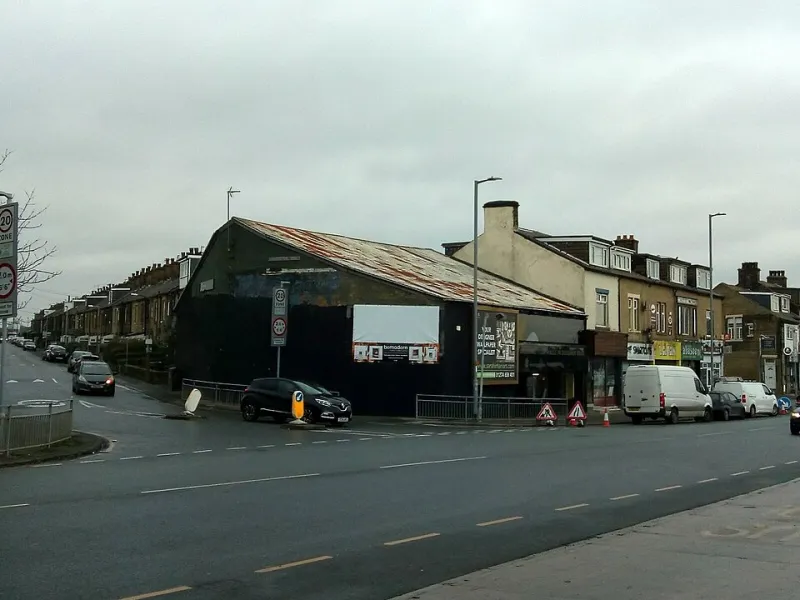
Photo: Chris Holifield , CC BY-SA 2.0, via Wikimedia Commons
There is a strip of masking tape on a balcony handrail at an old cinema I pass through whenever I can. It is yellowed, curling at one corner, and it has been there so long that the paint beneath has faded to a different shade entirely. Nobody remembers who stuck it down. Nobody is in a rush to peel it off.
That tape is a small thing, but it opens a big question. Walk into almost any pre-war picture house in Britain and you are stepping through a century of tiny decisions made by people who needed the doors open by seven and had very little money to make it happen. Conservators call the material record of all that activity the building's fabric. The rest of us might simply call it the scars.
Where the real story hides in the small repairs
The terrazzo gets the photographs. The organ gets the fundraising appeal. The plasterwork picked out in gold gets the listing. All of it deserves the attention. But the part of a cinema that actually tells you how it survived is usually the part nobody designed: the overpainted frieze, the mismatched seat cover, the patched stair nosing, the pencil marks on the booth wall beside the porthole.
Historic England's conservation guidance leans on two unfashionable, deeply sensible ideas. Minimum intervention: do as little as you can get away with. Reversibility: make sure whatever you do can be undone by somebody with steadier hands in fifty years. Neither principle says leave everything alone. Both say be honest about what you are adding, and make sure the next person can tell the difference.
When the overpaint is the evidence
Consider a 1930s auditorium frieze that has been emulsion-painted four times. Strip it back and you will find the original colour scheme, which is thrilling. You will also find a corner where a brush slipped somewhere in the 1970s, and a patch where somebody painted around a light fitting rather than removing it. That sloppy afternoon is evidence too. It tells you the cinema was open, that a volunteer or a manager's brother-in-law had a spare Saturday, and that nobody expected the result to be examined under a conservator's lamp.
Which layer is the building? That is not a rhetorical question, and different sites answer it differently. A hall restored to its opening-night scheme is a legitimate choice. So is a room that admits its 1950s redecoration, particularly when that is the version three generations of local people actually remember. Community memory does not care about your earliest photograph.
The mismatched seat is a document
Seat upholstery is where running repairs turn almost archaeological. A row where one cover does not match the others usually means a burst pipe, a small fire, a scuffle, or a supplier going out of business halfway through an order. Some restoration teams now deliberately leave a single visibly mismatched seat in place rather than pretend an auditorium was always uniform. It is a five-second story that works on anybody: someone sat here, something happened, and the cinema carried on.
The same applies to hand-painted signage behind the screen, redundant door furniture, the ghost of a removed radiator, a floorboard cut to reach a valve. Individually they are trivia. Together they amount to a staff history of the building, written by people who never expected to be read.
The projection booth keeps its own diary
Upstairs is often where the best material survives, because nobody bothered to redecorate it. Pencil notes by the porthole. A hand-drawn exposure chart. A warning about the rectifier in capitals. A list of spares that stopped being accurate decades ago. In one booth I know of, the frame around a rewind bench carries a scratched tally of every film shown across a single summer.
None of this is decorative. It is the closest thing many small cinemas have to a staff archive, and it is exactly the sort of thing that disappears when a refurbishment begins with a skip on the pavement. Photograph it before anything else happens. Bag and label whatever comes off a wall. Write down who told you what, and when.
Keep, undo, record: a working ethic
So what should a volunteer-led restoration actually do? A few rules of thumb that hold up in practice:
- Decide as a group what the building is trying to say, and put it in writing before anyone picks up a scraper.
- Photograph everything at every stage, including the ugly bits.
- Keep samples of each paint layer and fabric you remove, labelled and stored somewhere dry.
- Be honest about additions. A modern repair pretending to be original is usually worse than one that quietly admits what it is.
- Never let character win an argument with structural safety or fire regulations. Nobody's heritage is improved by a failing balcony.
- Ask the people who used the place, not only the people who love the architecture.
The hardest judgement is knowing when a scar should stay. A hairline crack in plaster is history. A crack you could post a letter through is a problem. Conservation is not hoarding, and a cinema that cannot open is not being preserved — it is being embalmed.
Restored frame by frame, scars and all
The best restorations I have stood inside do not feel like costume drama. They feel like rooms that have been listened to. You can see where somebody stopped a leak in the 1980s and where a projectionist leaned against the same stretch of wall for thirty years. Read the joinery closely and the whole century is there.
Which is why I have never peeled that strip of masking tape off the handrail. Somebody put it there to stop a splice in the timber catching coats. It is still doing its job. Long may it.