The Frame on the Wall: In Defence of Britain's Hand-Painted Cinema Poster Cases
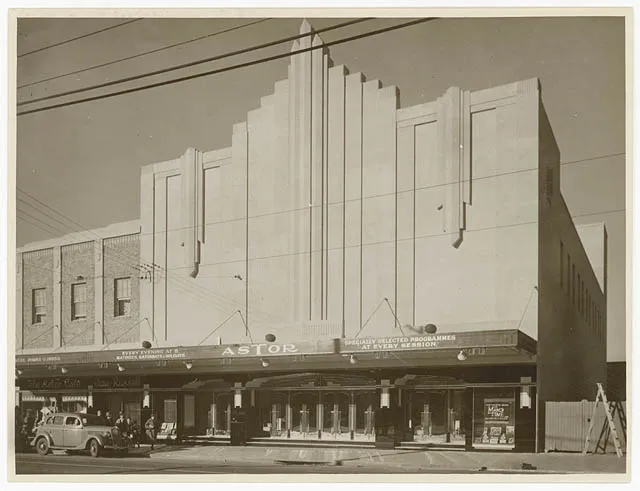
Photo: [Sam Hood, Public domain, via Wikimedia Commons
There is a particular sound attached to a poster case, and if you grew up near a picturehouse you probably still know it. Two small hinges, a brass catch, a sheet of glass swung out and propped against a shoulder while the week's bill was slid into place. Then the clunk of it shutting, and the little rattle that told you it had never quite fitted properly since about 1962.
It is a small piece of street furniture, and it is almost entirely gone. Which is why, whenever a cinema restoration gets its moment, we should be arguing about the frame on the wall as loudly as we argue about the seats inside.
The noticeboard that ran the street
A poster case is not a poster. It's a piece of architecture doing an advertising job. On a high street where the frontage is one continuous run of brick, stone or faience, the case is often the only thing at eye level that changes from week to week — the bit of the building that speaks.
And it spoke in a specific voice. Not the national artwork of the film, but the local version of it: the title in whatever lettering the signwriter fancied, the times written underneath in a hand that had settled into its own habits after thirty years. Some were classically tidy. Some leaned into flourishes and drop shadows and little painted arrows. A few were frankly eccentric, and those are the ones people remember.
There's a practical reason for the variety. For much of the twentieth century, and certainly in the decades after the war, a great many cinemas did not simply receive a poster and tack it up. They received a blank sheet, or a small-format print, and a signwriter made it work for that building, that town, that week. The lettering was sized to the glass. It was spelled the way the town spelled things. If the programme changed on a Thursday, somebody repainted on a Thursday.
What we lose when the vinyl goes in
Nobody is going to pretend that modern display is a scandal. A printed panel is cheap, weatherproof, legible and swappable in ten minutes by one person with a ladder. Cinemas run on thin margins and awkward rotas, and heritage arguments that ignore that are not arguments, they're moods.
But there is a real difference between a poster and a poster case, and it's the difference between a screen and a window. A backlit vinyl unit is a sealed product. It glows. It is identical in Leeds and in Leicester and in a multiplex in Reading. It tells you what's on, efficiently, in a typeface chosen by a brand team.
A painted board behind glass tells you something else as well. It tells you that a person stood outside this building on a wet Tuesday with a brush in their hand. That is not nostalgia — it's information about how the place worked, and who worked in it. When the last boards were painted out and the glass was replaced with a light box, a trade disappeared from the pavement, and the building lost its handwriting.
What actually survives
More than you'd think, and less than you'd hope. Original timber cases survive in reasonable numbers on interwar and post-war frontages, often painted over so many times that the mouldings have gone soft. Some are still glazed. Others have been blanked with ply, or boarded and forgotten, or converted into a cupboard for a meter.
Iron and bronze cases are rarer and heavier, usually fitted into a stone reveal, and they tend to survive precisely because taking them out was more trouble than leaving them. The really lucky ones — perhaps a few dozen nationally, at a guess — still have their original internal slatting, the thin wooden battens that held a painted card proud of the backing so the rain didn't sit against it.
What almost never survives is the artwork. Painted boards were, by design, disposable. They were scraped, repainted, or simply binned when the week was out. A handful of examples sit in local studies libraries and museum stores, and the odd one has turned up behind a radiator during a refurbishment, which is how most good cinema archaeology happens.
The knowledge survives a bit better, and it's worth catching now. Signwriters who worked for the old circuits are thinning out, and their recollections — what brushes, what paint, how long a board took, who decided the layout — are exactly the sort of detail that vanishes quietly and cannot be reconstructed from photographs.
The case for putting them back
Restoring a poster case is, on the scale of a cinema project, cheap. It is also disproportionately visible. You are handing the building back its voice on the street, and doing it at the one point where a passer-by who has never bought a ticket will actually look.
A few principles seem worth holding to.
Keep the frame. If the original case is there, even in a bad state, repair it rather than replacing it. New glass, new hinges, new slats, careful joinery: all fine. A modern aluminium unit bolted to a 1936 frontage is not fine, and it will be the first thing anyone notices.
Respect the listing. On a listed building, or in a conservation area, the case is usually part of the protected interest, and Historic England's guidance and local conservation officers will expect a proper justification for change. This is help, not obstruction. Use it.
Allow for handwork. A restored case is an opportunity, not an obligation, but where a cinema has a willing designer or letterer, letting them paint a board occasionally is the most authentic thing the building can do. Even if the usual display is printed, a painted changeover for a special screening or a restoration premiere connects the frontage to the programme inside.
Light it kindly and lightly. A discreet, warm, low-level fitting inside the case reads almost exactly like the old arrangement and does far less damage to the frontage than a surface-mounted LED panel.
Talk to the people who did it. If there's a retired signwriter in the town, someone in the local civic society will know. Ask them what the case looked like in 1974. Ask them what colour the boards were. Ask them to paint one. It is astonishing how often this works.
One frame at a time
A restored cinema is usually discussed in terms of what happens once you're through the door — the seats, the curtain, the light from the booth. All of that matters. But the first thing a picturehouse does is stand on a street and tell people what's on.
We spent most of a century letting that job be done by hand, by people who took it seriously and occasionally got a bit carried away with the serifs. Putting a proper glass case back on the wall, and letting somebody's lettering sit in it, is one of the least expensive ways to make a restored building feel like it never stopped being a cinema.
Coming soon, painted by hand. It's a good look. It was always a good look.