Keeping Time in the Dark: Britain’s Cinema Clocks and the Volunteers Winding Them Back
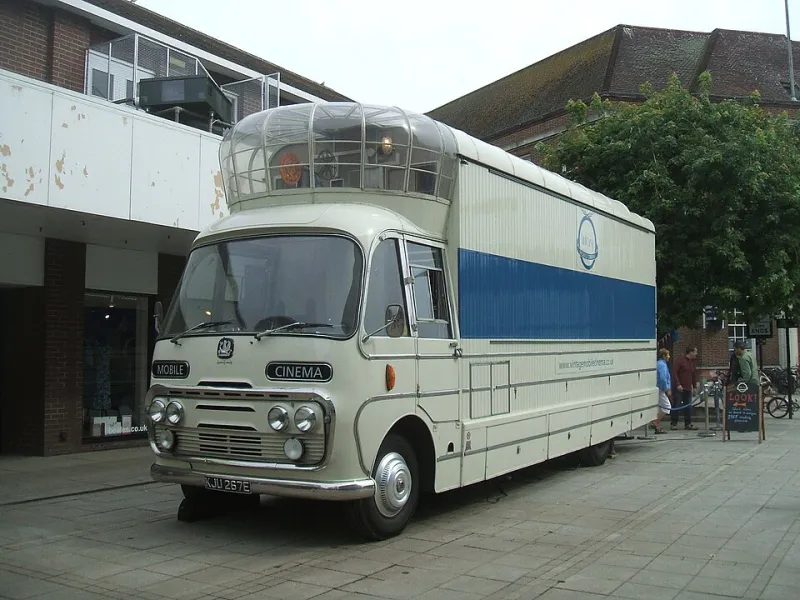
Photo: Rose and Trev Clough, CC BY-SA 2.0, via Wikimedia Commons
Walk into an old picturehouse and your eye goes to the obvious things: the proscenium, the balcony, the lights along the aisle. It rarely goes to the circle above the screen. In many auditoriums that circle is still there — a plaster medallion, a ring of painted numerals, a pair of hands frozen at ten past something. It is a clock, or it was. And in a surprising number of British cinemas, it is the last working part of the room that nobody has got round to fixing.
The Clock That Ran the Evening
Before multiplexes, a night at the pictures was a sequence, not a single event. There was the newsreel, the cartoon, the second feature, the interval, the big film. Somebody had to keep all of that from sliding into the next showing, and the auditorium clock was part of how they did it. Managers timed the interval by it. Ushers glanced at it. The projectionist, in the booth at the back, worked to a matching clock or a set of cue bells, so that the lights came up when the reel ended rather than when someone remembered.
Many of these clocks were never meant to be showpieces. They were practical, often electric, frequently driven by a master clock elsewhere in the building and pulsed round the circuits so that every dial agreed. Others were mechanical, wound weekly, with a faint tick that carried only as far as the front stalls. A few were illuminated from behind, glowing softly through opal glass — less a timepiece than a nightlight with numbers.
What made them clever was that audiences stopped noticing them. A good auditorium clock told you the time without demanding that you look. That is a difficult trick to restore.
Why They Stopped
The disappearance was rarely dramatic. A movement failed and there was no one to repair it. A ceiling was replastered and the hole was filled. An auditorium was subdivided, and the clock ended up in a screen that no longer had a stage beneath it. In some buildings the dial was painted over; in others it was removed and the space fitted with a speaker, a fire alarm beacon or a blank disc of acoustic board.
By the 1980s, cheap quartz clocks had made the old dials look like clutter, and a battery-operated wall clock near the exit did the job for a fraction of the cost. Nobody set out to erase a small piece of cinema architecture. It simply stopped earning its keep, and in a building where every square foot is fought over, that is usually enough.
What Survives, and Where
Enough survives to make the case. Listed picturehouses often retain their dials because the clock was part of the original decorative scheme, and consent is needed to touch it. Others have been brought back by volunteers who found the original hands in a cupboard and the movement in a box marked ‘various’. A handful of British cinemas now run an auditorium clock again, sometimes on a modern movement hidden behind the old face, sometimes on the original mechanism, wound by hand.
The range is part of the pleasure. Some are plain enamelled dials with brass hands. Some are Art Deco sunbursts. Some are set into a decorative panel above the proscenium, so that the clock reads as part of the architecture rather than an addition to it. Once you start looking up, you notice how many high streets still have one — and how many are stopped.
The Repair Bench
Restoring a cinema clock is rarely a matter of swapping in a new battery. The movement may be an impulse type that needs a master clock to drive it, or a synchronous motor that runs from a supply nobody has anymore. The hands may be missing; the glass may be cracked; the numerals may have been overpainted during a 1970s refurbishment that also did for the cornice.
Clockmakers who normally work on longcase clocks are the people to ask, and many volunteers have found one locally. Parts are the real problem. A 1930s impulse movement has no catalogue to order from, so a repair may mean making a new wheel or coaxing a worn one back into service. Access is another cost: reaching a clock above a proscenium usually means a scaffold tower, a licensed electrician, and a conversation with the insurer. In a listed building, there is also the small matter of consent.
None of that is glamorous. All of it is typical of the work that fills the gaps between the big restoration milestones — the seating, the screen, the sound. A clock is a finishing touch that arrives, if it arrives at all, long after the lights have been switched back on.
The Finishing Touch
There is a case for leaving a stopped clock alone. It is honest, in its way: a visible reminder of what the room has been through. But a working one does something that a plaque cannot. It gives the evening a rhythm again. It tells you, without a word, that the interval is nearly over. It makes the auditorium feel looked after, in the way that a swept floor or a lit foyer does.
It also matters because the clock is shared. Everybody in the room can read it. In an era when we check the time on our own phones, a public dial above the screen is a small, stubborn piece of collective life — one that belonged to the building rather than to any one person in it.
Winding On
If your local picturehouse has a blank circle above the screen, it is worth asking what used to be there. The answer may be in an old photograph, a conservation report or the memory of someone who worked the interval. The Picture House Project would like to hear those stories, because a clock is easy to lose and surprisingly hard to argue for once it has gone.
Restoration is often described as bringing a building back. Sometimes it is smaller than that: a dial, a pair of hands, and the quiet business of setting them right.