The Sixpence Republic: What Saturday-Morning Cinema Clubs Taught Britain About Belonging
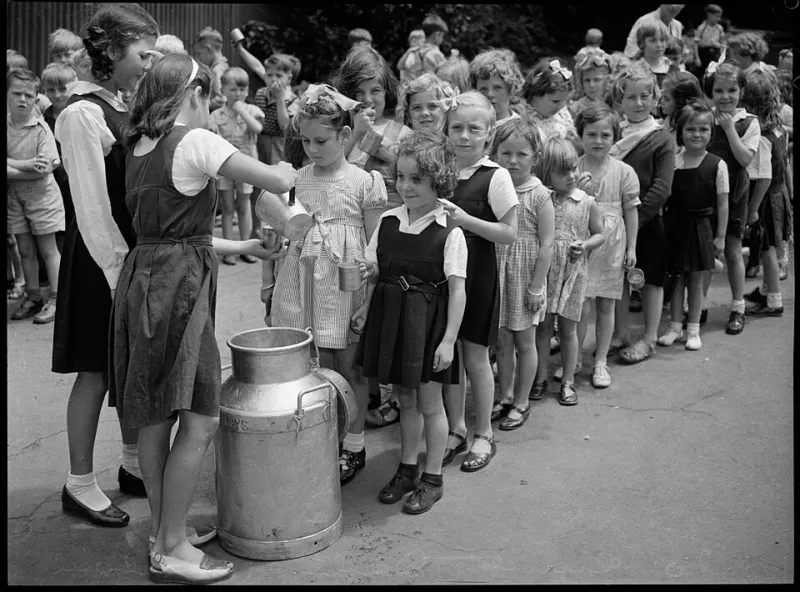
Photo: Robert Rice, Public domain, via Wikimedia Commons
Walk past a certain kind of British picturehouse on a Saturday morning and you can almost hear it: the queue shuffling along the side wall, the clink of coins, the smell of sweets and floor polish, and the low roar of children who have been deposited for two hours of cartoons, serials and cowboys. The Saturday-morning cinema club was not simply childcare with a screen. It was a weekly republic of the young, run on sixpence, ritual and a clipboard.
For anyone interested in cinema heritage, these clubs matter because they show that a picturehouse was never just a room where films happened. It was a social machine. It had a queue, a membership card, a birthday list, a club song and a volunteer who knew which child had been left behind by an older sibling. In the middle of the twentieth century, the ABC Minors and the Odeon children’s clubs turned the Saturday matinee into a standing appointment for generations of British children. The films were the draw, but the belonging was the product.
A queue with its own rules
The queue was the first performance of the morning. Younger children clustered near the front, clutching coins and looking anxiously for a friend. Older ones arrived in loose gangs, pretending not to care. Mothers and grandmothers hovered at the edges, judging whether the queue was moving and whether the film would be suitable. The commissionaire or usher at the door became a figure of authority, but the real government of the queue was informal and ferociously policed by children themselves.
Inside, the rules shifted again. Seats were claimed with coats. The back rows belonged to the big kids. The front rows were for the devoted and the short-sighted. There was a moment, just before the lights went down, when the noise was enormous and completely ordinary. Then the curtains parted, the projector threw its beam through the dust, and the room settled into a different kind of attention.
That transition is hard to recreate with a streaming queue at home. It depends on architecture, yes, but also on numbers. A Saturday club worked because there were enough children in the room to make a collective gasp feel like weather. One child watching a cliffhanger is suspense. Two hundred children watching it is a event.
Sixpence, sweets and the week-long cliffhanger
The admission price is the detail everyone remembers. Sixpence sounds impossibly small now, but the point was not just cheapness. It was accessibility. The Saturday club was designed to fit a child’s pocket money and a parent’s weekly budget. It sat alongside the sweetshop and the bus fare as part of a local economy of small pleasures.
The programme was equally important. A cartoon, a serial episode, a comedy short and a cowboy double-bill could fill a morning with the kind of variety that modern family programming rarely attempts. Serials were especially potent. They ended on a cliffhanger, and the cliffhanger had to survive until the following Saturday. Children carried the question around with them for a week, arguing in playgrounds and on street corners about whether the hero could really have been crushed by that falling beam.
This was community built on delayed gratification. You could not binge the serial. You had to wait, and waiting made the shared experience stronger. The club created a weekly conversation that belonged to the children themselves, not to their parents or teachers.
The clipboard people
The clubs depended on adults who were willing to do unglamorous work. Cinema managers, ushers, projectionists and volunteers ran the membership lists, organised competitions, handed out badges and kept some kind of order. They were not simply supervising a screening. They were running a club in the old-fashioned sense: a named group with rituals, responsibilities and a mild sense of ownership.
Some of that labour was practical. Someone had to count the takings, check the certificates, manage the queue and deal with the child who had lost his bus fare. Some of it was emotional. Birthday announcements, lost-property appeals and the gentle business of learning names turned a cinema into a place where children were known. In heritage terms, that is gold dust. The fabric of a building can be restored, but the memory of being known is what makes a place feel like it belongs to a community.
It is also a reminder that volunteers are not a modern invention. The Saturday club had its own ecology of willing adults, many of them doing jobs that were never written into a formal job description. Their stories are exactly the sort of oral history that cinema heritage projects should be collecting while they still can.
What a restored picturehouse can do with a Saturday
In 2026, restored picturehouses across Britain are looking for ways to be useful beyond heritage tours and evening screenings. The Saturday-morning club offers a model that is hiding in plain sight. It does not require a multiplex budget. It requires a room, a programme, a sensible ticket price and a group of people who are prepared to make it a regular appointment.
The ingredients are not complicated: affordable admission, a mixed programme of short films and a feature, a visible club identity, and a partnership with local schools, libraries or community groups. A restored cinema can add the thing that streaming cannot: a room full of other people, a foyer that fills up, and the small civic theatre of children queuing together on a high street.
There is a temptation to make such events overly precious. Heritage venues sometimes worry that children will damage the paintwork or disturb the atmosphere. But the Saturday club was never precious. It was raucous, sticky-floored and occasionally chaotic. That was part of its charm. A restored cinema that cannot survive a bag of sweets and a hundred excited children is not really a community cinema yet.
The mess is part of the memory
The sixpence is gone, and the serials have lost their weekly grip. But the principle remains. Children still want to belong to something that happens at a particular time in a particular place. Picturehouses still have the rooms. What they need is the clipboard, the queue and the willingness to let Saturday morning be a little bit noisy again.
That is not nostalgia for its own sake. It is a practical lesson from the history of British cinema-going. The Saturday-morning club worked because it treated children as a public, not an inconvenience. Restored cinemas in 2026 could do worse than remember that.