The Push That Takes You Back: Britain’s Cinema Doors and the Hardware of Arrival
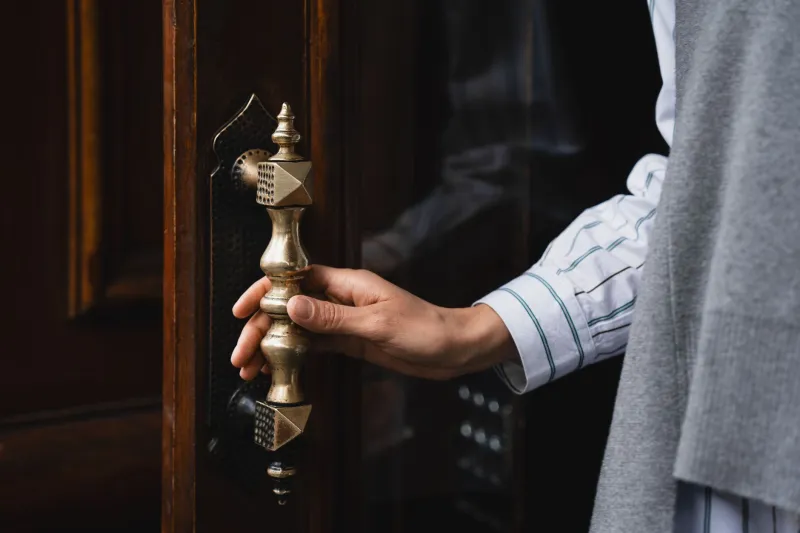
Walk into a restored picturehouse and the first thing that greets you isn’t the screen. It’s a door. Not the film, not the smell of popcorn, not the hush of the auditorium — just a slab of timber, glass and metal that asks you to push, pull or pause. And yet, in most restoration plans, the door is an afterthought. The seats get upholstered, the curtains get cleaned, the projector gets its moment in the spotlight. The handle? It gets a rub with Brasso if it’s lucky.
The first handshake
There’s a reason we remember certain cinema entrances. A proper picturehouse door has weight. It resists you slightly, then gives way with a satisfying thunk. The brass push plate is cool under your palm. The kickplate at the bottom is scuffed in a way that suggests thousands of Saturday mornings, school-holiday matinees and late-night double bills. You don’t just enter a cinema; you negotiate with it. And that negotiation starts at the hardware.
In heritage terms, these fixtures are tiny. A Bakelite handle is not a balcony. A letterbox plate is not a canopy. But they are the details that turn a building into an arrival. They are also the bits most likely to go missing during a refurbishment — swapped for a generic stainless-steel bar from a builder’s merchant because the original was “a bit worn” or “not to current standards.”
Brass that remembers
Brass has a particular hold on cinema memory. It warms to the touch. It polishes up to a glow that feels deliberately theatrical. On a wet Tuesday in November, a brass push plate on a picturehouse door is one of the few things on the high street that still feels like it belongs to another era — not because it’s old, but because it was made to be used and kept.
Volunteers restoring smaller cinemas often find that the brass is still there, just buried under layers of paint. A push plate that has been overpainted six times can be rescued with a heat gun, a plastic scraper and patience. The trick is not to polish away the wear. Those shallow depressions where thumbs have pressed for decades are part of the object’s story. A restoration that erases them is just a replacement with extra steps.
Bakelite, kickplates and the archaeology of wear
Not every door fitting is brass. Bakelite handles — dark, mottled, slightly tactile — turn up in interwar and post-war picturehouses, often on inner doors or vestibule entrances. They chip. They fade. They can be repaired with epoxy putty coloured to match, but finding a replacement is harder. The same goes for original finger plates, letter flaps and the small brass signs that once said “Push” or “Pull” in a typeface no modern sign-maker would choose.
Then there are kickplates. A cinema door’s kickplate is a record of use: the scuffs of Clarks shoes, school shoes, Doc Martens and the occasional ice-cream-induced scurry. A worn kickplate is not damage. It’s evidence. Conservation-minded volunteers increasingly argue for keeping original kickplates where possible, or reproducing them in a metal that will age honestly rather than a plastic laminate that will peel in five years.
Sourcing the impossible: volunteers and the small parts network
Ask anyone who has worked on a cinema restoration about door furniture and you’ll hear the same word: “lucky.” You get lucky when a matching handle turns up in a box of bits donated by a former projectionist. You get lucky when a local architectural salvage yard has four identical push plates from a demolished Odeon. You get lucky when a retired engineer offers to cast a new one from an original.
That luck is rarely accidental. It’s the result of volunteers building networks — swapping photographs on forums, measuring handles with digital callipers, posting wax rubbings of decorative plates to fellow enthusiasts. The small hardware of British cinemas is being saved by a loose, informal supply chain of people who understand that a 1930s door handle is not a trivial thing.
Remanufacture without erasing history
Sometimes the original is beyond repair. In those cases, remanufacture is the honest option — but only if it’s done with care. A new brass push plate cast from an original pattern can look right, feel right and age right. A 3D-printed plastic replica will not. The goal is not to fool anyone; it’s to keep the door working as it was designed to work, so that the experience of arrival remains intact.
This is where restoration debates get interesting. Should a door be brought up to modern fire-safety standards with new closers and seals? Yes. Should that mean losing the original handle in favour of a push bar? Not necessarily. There are ways to integrate modern hardware discreetly, keeping the original fittings as the public face and the modern safety kit tucked behind the scenes. It costs more thought. It costs less than losing the character of the entrance.
A door is a promise
The screen may be the reason you bought a ticket, but the door is the promise. It says: something is about to happen. The lights will go down. The curtains will part. You will be somewhere else for a while. That promise is carried in the weight of the timber, the temperature of the brass, the slight resistance of a well-oiled hinge.
So the next time you push through the doors of a restored picturehouse, pay attention to your hand. What does it feel? A generic bar, or a handle that has been cared for? A kickplate that has been replaced with something neat and forgettable, or one that still carries the marks of a thousand Saturday mornings? The smallest surviving hardware can carry the strongest sense of arrival. It deserves a line in every restoration plan — and a bit of Brasso.
Tell us about the doors you pushed
We’re collecting memories of cinema doors across Britain: the heavy ones, the sticky ones, the ones with handles that came off in your hand, the ones that swung open onto a world of red velvet and darkness. If you remember a particular picturehouse door — its weight, its sound, its hardware — we’d love to hear from you. Drop us a line, and help us keep the small details of arrival alive.