When the Bingo Caller Moved Out: The Picturehouses That Found Their Way Back to Film
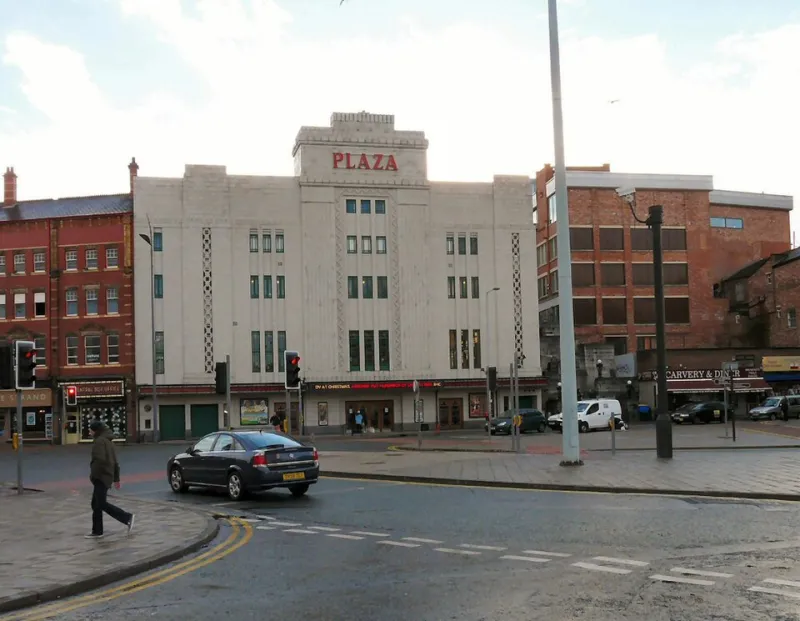
Photo: Gerald England , CC BY-SA 2.0, via Wikimedia Commons
On a wet Tuesday in Stockport, the Plaza's foyer smells of coffee and old stone. The canopy still does its grand job of announcing that you are about to go somewhere. Inside, the auditorium opens up in that unmistakable cinema way: the rake, the circle, the proscenium arch, the sense that a hundred small rituals used to happen here before the lights went down. The Plaza is a survivor, but not a simple one. Like a number of British picturehouses, it has known life as something other than a cinema, and then come back.
That pattern is worth paying attention to in 2026. We are used to stories of closure. We are less used to stories of return. Across the UK, former cinemas that spent years as bingo halls, supermarkets, churches or furniture showrooms have been coaxed back into use as cinemas, arts centres or community venues. Each one is a lesson in what survives when a building stops being the thing it was built for.
The building remembers
Architecture keeps receipts. In a cinema that spent decades as a bingo hall, the auditorium often survives because bingo needed volume, not intimacy. Operators might drop a suspended ceiling, cover plasterwork, take out seating and paint over decorative schemes, but they rarely demolished the shell. The stage stayed. The circle stayed. The organ chamber might have been boarded up. When campaigns finally began, they found a time capsule under the tiles.
Stockport's Plaza is the obvious case, and it is a good one because it is not a museum piece. It is a Grade II* listed super cinema that has had to earn its keep in different ways. Its restoration is often told as a story of plasterwork and lighting, but the more interesting story is one of use. A building like this survives because people keep finding reasons to open the doors. Film is now one of those reasons again, alongside live events, tours and the ordinary business of running a venue.
Bingo was, in its way, an accidental custodian. It kept the lights on and the roof repaired, even if it did not keep the projectors running. Supermarkets and churches were less gentle. A supermarket wants a flat floor and fluorescent light; a church wants a different kind of auditorium. Both can erase the small clues that tell you this was once a place of shadows and projected light. But even then, the shape of the building often gives the game away: a high street façade too grand for its current use, a side entrance, a canopy, a row of decorative panels above a shop sign.
The campaign is the comeback
No building comes back because of architecture alone. It comes back because a group of people decides that the loss would be too great. The campaigns vary. Some are led by local trusts. Some begin with a public meeting and a photograph. Some use share offers, some rely on volunteers, and many lean on the National Lottery Heritage Fund or the Architectural Heritage Fund. The paperwork is formidable. The romantic bit is the plasterwork; the reality is drainage, asbestos, fire doors and access.
What these campaigns share is a belief that a picturehouse is more than a room with a screen. It is a landmark, a meeting place, a bit of civic memory. The people who bring one back are rarely trying to recreate the past exactly. They are trying to give the building a future that is worthy of its past. That is a different ambition, and a harder one.
The volunteers matter here. A restored cinema often runs on people who will clean the brass, staff the bar, guide the tours and explain the history to visitors. They are the ones who turn a funded project into a living place. Without them, a restoration can become a beautifully lit shell.
What the second act asks of us
A cinema-to-bingo-to-cinema resurrection is not really a reversal. It is a third act. The building has to serve an audience that did not exist when it was built, with habits that would have baffled its original manager. Parent-and-baby screenings, subtitled shows, community groups, live comedy, podcast recordings: these are not distractions from cinema heritage. They are the proof that the building still works.
The danger is treating the past as a diorama. A listed auditorium can become so precious that nobody dares put a chair out of place. But the best restorations remember that cinemas were always practical places. They were warm, noisy, occasionally chaotic, and run on tight margins. The ghost of the bingo caller is not an embarrassment. It is part of the social history of the building, and it deserves to be recorded alongside the film programmes.
So next time you see a faded canopy on a high street, look for the clues. A bingo board bracket. A covered ceiling. A stage that seems too big for the shop below. The building may be waiting for its next act, and the people who bring it back will need more than nostalgia. They will need patience, money and a very good rota.